Contract terms reference
Liability caps
General information on how to draft liability caps — not legal advice.
What a liability cap actually does
A liability cap sets the maximum compensation payable for covered claims; it does not remove responsibility for a breach. Insurance may fund that payment, but its coverage limit does not automatically become the contractual cap. In negotiations, "liability cap" and "limitation of liability" often describe the same financial ceiling, although a limitation clause can also exclude particular losses.
How to set a liability cap: three methods
A rolling fee cap uses the formula: cap = the fees paid or payable in the preceding 12 months. Suppliers often prefer this method for recurring services because exposure follows the revenue associated with the relationship, rather than the buyer’s wider business operations. Including both paid and payable fees matters: a paid-only version would omit outstanding invoices. The weakness is variability: reduced usage, discounts or a pause in service can lower the amount even while the customer’s dependence on the service remains unchanged. The calculation also looks backward, so it may reflect an earlier, smaller deployment after the service has expanded. This formula needs an anchor: “preceding” here means before the event giving rise to the claim.
A fixed cap uses the formula: cap = $50,000. It produces the same dollar ceiling regardless of invoicing history, making the amount available from signature without waiting for fees to accumulate. Buyers often prefer this structure when fees are small compared with their dependence on the supplier; sellers may prefer it when they need a known maximum that does not grow with sales. Its weakness is that the number does not adjust itself. A $50,000 figure agreed for a short pilot remains $50,000 if the arrangement expands to additional locations or a larger workload, unless the contract changes. Conversely, the same amount may become disproportionately large for a service whose scope has substantially reduced. Administrative simplicity therefore comes with a need to revisit the figure when the work changes.
A fee multiple uses the formula: cap = 2 × annual fees. With annual fees of $120,000, the cap is $240,000. Buyers often prefer a multiple to a single year’s fees because it provides more compensation without disconnecting the figure from contract revenue. Sellers may accept that structure because the amount remains calculable from the commercial terms. The multiplier applies to fees, not losses: annual fees are identifiable at signature, whereas the amount of a future loss is unknown. Multiplying the eventual loss by two would increase the compensation calculation rather than establish an agreed ceiling in advance. This method’s weakness is its dependence on the fee base. Usage charges, credits and optional services can make “annual fees” uncertain, while low fees can still produce a modest cap even after multiplication.
What the three methods produce on the same contract
The numbers only mean something side by side. Take a two-and-a-half-year services agreement worth $300,000 in total fees, billed at $120,000 a year, and apply each method to it.
| Method | Cap for this contract | Share of total fees |
|---|---|---|
| Fixed sum | $50,000 | 17% |
| Fees paid or payable in the preceding 12 months | $120,000 | 40% |
| 2 times annual fees | $240,000 | 80% |
The spread is the point: the same contract produces caps that differ by almost five times, and none of the three is wrong on its face. What separates them is how they behave as the contract runs. The fixed sum stays where it is, so if the contract is extended or the fees rise, the customer's recovery does not follow. The 12-month figure moves with the fees actually charged in the window before the claim. The multiple of annual fees moves with the contract value.
Before choosing, put the cap next to the loss it is meant to cover. A cap of 17% of contract value may be adequate where the worst likely loss is a few months of wasted fees, and unreasonable where the deliverable is embedded in the customer's own product.
What a cap usually does not cover
- Fraud and willful misconduct: Contracts typically leave deliberate deception and intentional wrongdoing outside the general cap. The commercial rationale is to avoid giving dishonest conduct a predetermined financial limit. This distinguishes deliberate acts from ordinary performance failures.
- Personal injury and death: These claims are usually treated separately because they concern harm to people rather than the economics of the service. Commercial fees rarely reflect the potential consequences. The exception often focuses on harm caused by the responsible party.
- Breach of confidentiality: Buyers often seek an exception because disclosure can destroy information’s commercial value. The damage may continue after the contract ends. Negotiated agreements also commonly use a separate confidentiality cap instead of unlimited exposure.
- Intellectual property infringement: Customers often seek uncapped protection because supplied technology or materials may expose them to claims by an outside rights holder. They typically rely on the supplier’s authority to provide those assets. A separate higher cap is another common treatment.
- Unpaid fees: Payment obligations are typically excluded so a customer cannot use the damages cap to reduce an agreed invoice balance. Those fees represent the contract price. Treating them separately preserves the distinction between payment and compensation for failed performance.
- Insured losses: Buyers often request an exception for amounts recoverable under insurance to preserve access to that funding above the general cap. The rationale is that insured recovery should remain available. This treatment is negotiated, rather than a universal default.
- Data breaches and regulatory fines: Buyers often seek exceptions because incident response and claims from affected people can extend beyond the immediate service relationship. A separate data liability cap is also common. Fines need distinct treatment: a reimbursement clause does not itself establish that a particular penalty can be transferred.
Three sample cap wordings
(a) (1) Subject to any liability expressly excluded from this cap elsewhere in this Agreement, Supplier’s total aggregate liability to Customer arising out of or in connection with this Agreement, whether for breach of contract, negligence, under an indemnity or otherwise, shall not exceed the fees paid or payable by Customer to Supplier under this Agreement during the 12 months immediately preceding the earliest event giving rise to any claim subject to this cap. (2) That amount shall constitute one combined ceiling for all claims subject to this cap throughout this Agreement and after its termination, and shall not reset or increase because further claims arise. (3) Amounts paid to satisfy any such claim shall reduce the remaining amount available under that ceiling for all other claims subject to this cap.
Replace 12 with the agreed lookback period; the fee amounts come from the actual Agreement, not from this sample.
(b) (1) Subject to any liability expressly excluded from this cap elsewhere in this Agreement, Supplier’s total aggregate liability to Customer arising out of or in connection with this Agreement, whether for breach of contract, negligence, under an indemnity or otherwise, shall not exceed $50,000. (2) This amount shall constitute one combined ceiling for all claims subject to this cap throughout this Agreement and after its termination, irrespective of the number of claims, the fees paid or payable, or the date on which a claim is made. (3) Amounts paid to satisfy any such claim shall reduce the remaining amount available under that ceiling, which shall not reset or increase because further claims arise.
Replace $50,000 with the agreed fixed amount for this transaction.
(c) (1) Subject to any liability expressly excluded from this cap elsewhere in this Agreement, Supplier’s total aggregate liability to Customer arising out of or in connection with this Agreement, whether for breach of contract, negligence, under an indemnity or otherwise, shall not exceed 2 times the annual fees. (2) For this cap, annual fees means the agreed annual fee amount of $120,000, and the resulting ceiling shall apply to all claims subject to this cap throughout this Agreement and after its termination. (3) Amounts paid to satisfy any such claim shall reduce the remaining amount available under that ceiling, which shall not reset or increase because further claims arise.
Replace 2 and $120,000 with the agreed multiplier and actual annual fee amount.
Liability cap vs indemnity vs limitation of liability
A cap answers "how much?" It sets a financial ceiling for the claims within its scope. The amount alone does not establish which liabilities it covers.
An indemnity answers "who pays for this specified risk?" Contracts often use it for third-party claims, such as intellectual property infringement, with accompanying terms governing defense costs, settlement approval and control of the response. Some indemnities also cover losses suffered directly by the other contracting party.
Limitation of liability is the broader framework. It typically houses the general cap, exclusions of specified losses, and exceptions that receive a higher cap or no cap.
In practice, the indemnity clause sets out the payment obligation and claims procedure; the limitation clause identifies the applicable ceiling and exclusions. An indemnity does not automatically sit outside the cap. State its treatment expressly, including whether defense costs consume the available amount.
When these provisions share one clause, keep those functions distinct; when they sit separately, cross-reference them so each indemnity can be traced to its applicable cap and exclusions.
A clause-by-clause reading of the ceiling itself is covered in how to read a limitation of liability clause, and the payment side in what an indemnity clause actually covers.
Mistakes in calculating the cap
“Liability shall be limited” leaves the calculation unfinished. The wording needs an identifiable amount or formula: a fixed sum, specified fees, or a multiple of those fees. Without that basis, neither party can calculate the proposed protection from the signed agreement.
A fee-based formula also needs an anchor date. “Fees paid or payable in the preceding 12 months” becomes usable only when the agreement identifies the event that fixes that window. Otherwise, the parties may calculate different amounts using the breach, discovery, notification or claim date.
Do not confuse the amount used to calculate the cap with the loss being claimed. Under a formula of 2 times annual fees, the multiplier applies to the agreed fee base. It does not multiply whatever loss the customer later reports.
Finally, check whether the fee definition matches the commercial documents. An order form may separate implementation, license, support and usage charges. If the cap refers only to “service fees,” the parties may disagree about which charges count. Resolve that wording against the actual fee schedule before signature.
Mistakes in defining what the cap covers
An insurance limit is not a substitute for a contractual ceiling. A policy describes the insurer’s potential payment obligation, subject to its terms; the contract describes the supplier’s responsibility to the customer. Copying an insurance figure into negotiations does not establish how either obligation works.
Another mistake is using an unrestricted phrase such as “all liability” without addressing fraud, willful misconduct, personal injury and death. Contracts typically address these categories expressly because ordinary commercial limits are not intended to give deliberate wrongdoing or serious personal harm the same treatment as a service failure.
Read the cap alongside every indemnity. An indemnity can promise payment for specified claims while leaving its relationship with the general ceiling unclear. Identify whether those payments count toward the cap and whether defense costs reduce the remaining amount.
Also distinguish a monetary limit from an exclusion of losses. A contract can name a substantial cap while excluding the losses most likely to arise. Review both provisions together so the stated amount corresponds to compensation that could actually be recovered.
Product report screenshot
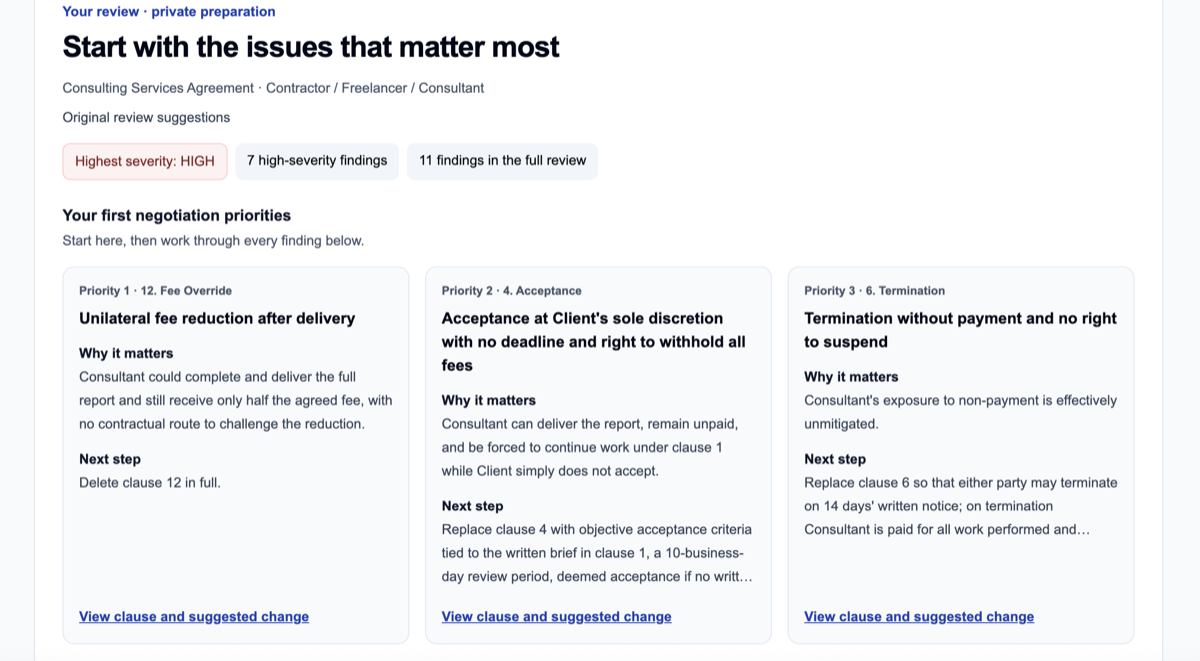
An extract from a review of a fictional consulting agreement. Each finding shows the clause, why it matters and the next step, and the full report is downloadable as a PDF.
Frequently asked questions
Is a liability cap the same as a limitation of liability?
A liability cap is the monetary ceiling within a limitation of liability arrangement. The broader clause may also exclude specified losses or identify liabilities outside that ceiling. In drafting, distinguish the amount from its scope: knowing the cap does not establish whether a particular claim falls within it or whether the claimed loss is recoverable.
What is a typical liability cap?
Common approaches include fees paid or payable in the preceding 12 months, a fixed sum, or a multiple of annual fees. For example, $50,000 and 2 times annual fees use different calculation methods. A suitable amount depends on the services, the commercial arrangement and the exposure being allocated; a familiar formula alone does not establish suitability.
Which date should anchor a fee-based cap?
A fee-based cap should identify the event used to select the relevant fees, such as the event giving rise to the claim. The chosen wording determines which invoices enter the calculation. Compare the cap clause with the payment schedule and claims procedure so a delayed invoice or later notification does not create competing calculations.
Does an indemnity automatically fall outside the cap?
An indemnity does not automatically fall outside a liability cap merely because it appears under a separate heading. Its treatment depends on the wording connecting the provisions. State whether the cap applies to the indemnity, which covered payments count toward it, and whether defense costs consume the same available amount as compensation.
Should a liability cap include indirect damages?
The cap should identify whether it applies to indirect damages that remain recoverable under the agreement. Decide separately whether particular losses are excluded, and check that the exclusion does not remove compensation the parties intended to preserve. Read the loss definitions with the cap; a monetary ceiling alone does not settle which losses remain recoverable.
A practical drafting checklist
Write the selected formula beside the commercial terms and calculate its result using the actual agreement. Match every input to an identifiable fee, amount or period. If a calculation requires an assumption that the documents do not answer, mark that assumption for clarification.
Trace the wording through the complete contract. Check definitions, order forms, statements of work, payment terms, indemnities and loss exclusions. An apparently clear cap can become uncertain when another document uses a different fee label or gives conflicting terms priority.
Confirm whether claims share an aggregate ceiling or receive separate limits. Read the provision as a whole rather than relying on the word “total” in isolation. Check how amounts already paid affect the remaining protection.
Then compare the result with a plausible failure under this transaction. Identify the costs that would remain with each party, and confirm the intended exceptions. Have a qualified legal professional review the complete wording before it is used in the signed agreement.
If the cap has to be checked against the rest of a drafted agreement, a clause-level review walks through the cross-references. A full review of the signed document starts at $29, and the sample report is free.
How buyers and suppliers can negotiate the cap
A buyer can open with a consequence rather than a demand for a larger number: “If the service fails during delivery, these are the costs the business would face. Which of those costs would this wording cover?” This connects the proposed amount to the transaction and makes exclusions part of the discussion.
A supplier can explain the calculation through the agreed work: “This cap uses the fees associated with the services being supplied. These charges count toward it, and this event fixes the calculation.” That explanation makes the offer easier to evaluate than describing the wording as standard.
If the positions differ, identify the exact source of disagreement. The issue may be the amount, the fee definition, the anchor date, the claims covered or the excluded losses. Changing the number alone may leave the underlying concern unresolved.
Record the agreed formula and scope in the contract, including any necessary cross-references. Before signature, calculate the result again from the final documents and confirm that both parties reach the same answer.